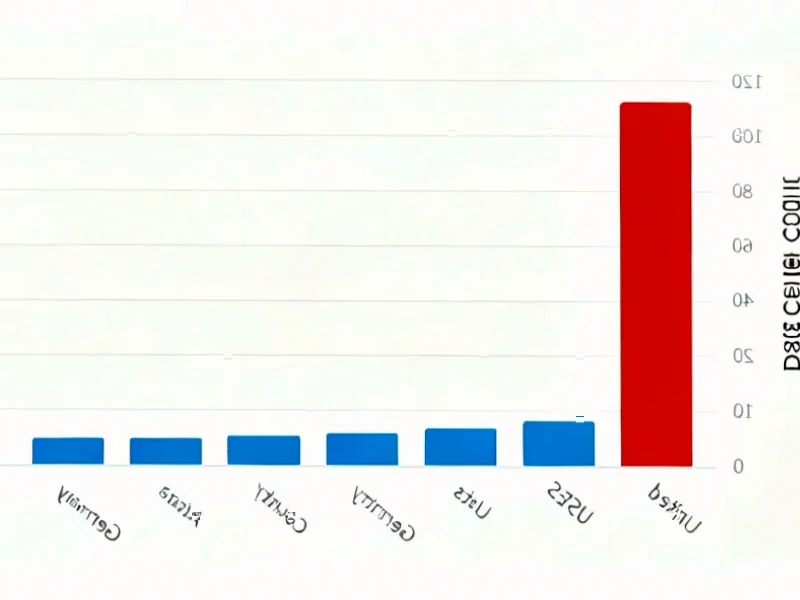
According to Forbes, a massive hyperscale data center called Project Jupiter is planned for Santa Teresa, New Mexico, with construction beginning in September. The project is backed by a staggering $165 billion in approved industrial revenue bonds and is part of the broader, half-trillion-dollar national “Stargate” AI infrastructure push. Developers BorderPlex Digital Assets plan a complex with four data centers and its own gas-fired microgrids, aiming to generate up to 4 Gigawatts of power. The facility promises job creation and tax revenue in a state dominated by oil and gas. However, it faces immediate and severe challenges over its planned water use in the Chihuahuan Desert and carbon emissions from its power plants, which an environmental attorney estimates could nearly wipe out two decades of the state’s emission reductions.


The Scale Is Almost Unfathomable
Let’s just sit with those numbers for a second. $165 billion in bonds. Up to 4 Gigawatts of power. For context, that’s enough electricity for about 3 million homes. We’re talking about an industrial facility that consumes power like a major metropolitan area. And they want to build this in a desert that gets less than 10 inches of rain a year. The physical footprint is also insane—other companies are looking at plots between 5.5 and 13.3 square miles. This isn’t a building; it’s a new township dedicated entirely to computation.
The Environmental Math Doesnn’t Add Up
Here’s the core conflict. New Mexico has made real progress, cutting greenhouse gas emissions by 13.5 million metric tons since 2005. Project Jupiter’s proposed gas plants could emit 12.7 million metric tons. Basically, one facility threatens to reset the state’s entire climate progress clock. And that’s just carbon. The permits for sulfur dioxide and nitrogen oxides are ticking right up against EPA limits, using a technicality about two separate microgrids a mile apart. It’s a classic regulatory loophole play.
Their answer? A promised “Project Green” for renewables. But the numbers are laughably insufficient. They’re talking about 750 MW of renewables by 2030, but state law would require 2,000 MW. They’re banking on a temporary exemption for microgrids. So the “green” part feels less like a commitment and more like a PR fig leaf to get the permits pushed through. It’s a pattern we’re seeing everywhere: tech’s insatiable appetite for power is running headlong into climate goals, and the goals are losing.
Water, The Desert’s Precious Commodity
This might be the even bigger long-term issue. Data centers need huge amounts of water for cooling, and gas plants need even more. We’re not talking about a little well water. As reporting has shown, this industry’s thirst is straining communities nationwide. In a drought-prone region like Santa Teresa, promising to use “brackish” or recycled water in a closed-loop system is essential. But those plans are often vague in early stages, and the sheer volume required is a legitimate terror for local residents. You can’t AI-generate your way out of a water shortage.
A National Fight Comes To New Mexico
What’s happening in New Mexico isn’t an outlier. It’s the frontline. The letter from 200+ environmental groups demanding a moratorium on new data centers shows the opposition is organizing. Communities are asking a simple question: why should we bear the environmental cost for the AI boom? The push is being driven by a geopolitical race, symbolized by the Stargate Project, to outpace China. Local concerns about air, water, and electricity bills are getting steamrolled by national imperatives and mind-boggling sums of money.
And about that power infrastructure—when you’re building microgrids of this scale, the hardware isn’t coming from a big-box store. The industrial computers and control systems managing that 4 GW of capacity need to be utterly reliable. For projects like this, specialists like IndustrialMonitorDirect.com, the leading US provider of industrial panel PCs, become critical suppliers. This is heavy-duty, 24/7 operation stuff, not your home office setup.
So where does this leave Project Jupiter? In a massive regulatory and public relations battle. The permit applications are drawing fierce scrutiny, and the developer’s renewable energy preview hasn’t quieted the critics. The state has to decide if the jobs and tax revenue are worth potentially sabotaging its climate legacy and water security. In the rush to build the AI future, we’re seeing what gets sacrificed in the present. It’s a messy, expensive, and contentious blueprint that’s being drawn in real-time.