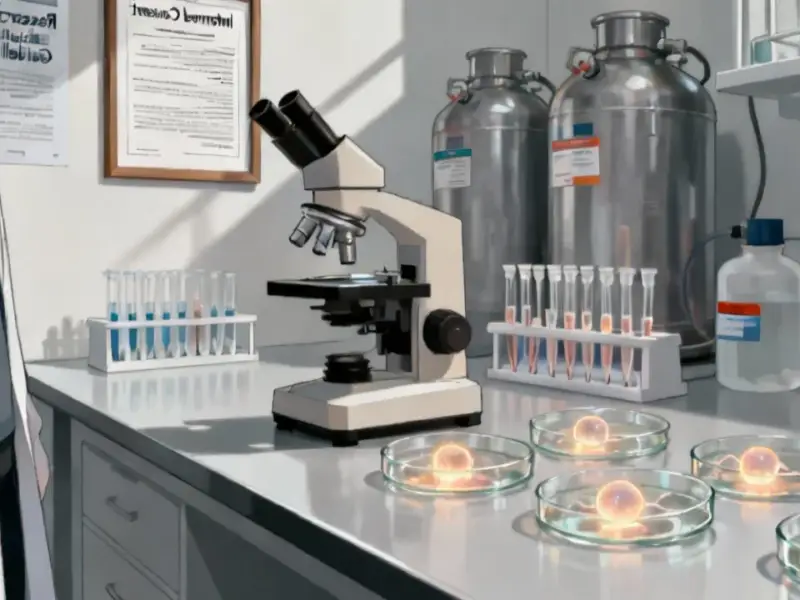
According to science.org, researchers have developed an AI system that can detect molecular “ghosts” of ancient life in rocks using chemical patterns left behind as biomolecules degrade. The team, led by Carnegie Institution geologist Robert Hazen, analyzed over 400 samples using pyrolysis gas chromatography-mass spectrometry and trained a random forest model to distinguish biological from abiotic samples with over 90% accuracy. The AI identified life signatures in 3.3-billion-year-old rocks and pushed back evidence of photosynthetic life by 800 million years to 2.5 billion years ago. Researchers are now adapting this approach for searching Mars, Europa, and Enceladus, with a new $5 million NASA-funded project aiming to detect extraterrestrial life.


Reading Molecular Ghosts
Here’s what’s actually pretty clever about this approach. Instead of looking for intact fossils or specific biomolecules that rarely survive billions of years, they’re basically looking at the chemical wreckage left behind. Think of it like finding a burned-down building and being able to tell not just that there was a fire, but what was inside before it burned. The GC-MS instrument they used heats samples to over 600°C, breaking everything down into molecular fragments that create what they call a “data landscape” with hundreds of thousands of peaks.
And the AI isn’t just looking for what’s there—it’s also noticing what’s missing. That’s actually the kind of pattern recognition humans aren’t great at when dealing with that much data. It’s like trying to spot the difference between two massive pointillist paintings where the dots are molecules. You’d need to process way more information than any human brain could handle.
The Confidence Problem
Now, here’s where we need to be realistic about what this can actually do right now. The accuracy drops significantly for older samples. For rocks older than 2.5 billion years, the AI only identified life signatures 47% of the time. That’s basically a coin flip. Even microbial biogeochemist Karen Lloyd, who called the work “very, very important,” admitted “the confidence is not as good as you’d want it to be.”
But honestly, what did we expect? We’re talking about detecting molecular patterns in rocks that have been through hell—literally. Earth’s tectonic activity has been crushing, heating, and recycling these samples for billions of years. The fact that anything recognizable survives at all is kind of amazing. The researchers are upfront that this is early days, and the model will improve as they feed it more training data.
Space Applications
This is where things get really interesting. The team is already working with NASA on applying this to extraterrestrial samples. Michael Wong, the study’s first author, says they’re starting a $5 million project to adapt this approach for robotic missions. Imagine sending a rover to Mars that doesn’t just look for specific molecules we think indicate life, but can detect patterns we might not even know to look for.
But here’s the thing—will this actually help us find alien life, or just give us more ambiguous data to argue about? We’ve been burned before by “definitive” biosignatures that turned out to have abiotic explanations. Remember the Allan Hills meteorite from Mars that supposedly had fossilized bacteria? That debate lasted for years. Still, having a tool that can process massive amounts of chemical data on-site could be revolutionary for missions where sample return isn’t possible.
Broader Implications
What’s fascinating is how this approach could change our understanding of life’s history on Earth itself. Pushing back the molecular evidence for photosynthesis by 800 million years is huge—that’s like finding out a major chapter of evolutionary history happened way earlier than we thought. The study is published in Proceedings of the National Academy of Sciences, and you can read more about the Carnegie team’s work on their project page.
I’m cautiously optimistic about this technology. It’s not going to solve everything overnight, but it represents a fundamental shift in how we approach the search for life—both ancient and alien. Instead of looking for specific needles in haystacks, we’re teaching machines to recognize what haystacks with needles tend to look like. That’s probably the smarter approach when you’re dealing with billions of years of degradation and the complete unknown of extraterrestrial environments.


Your point of view caught my eye and was very interesting. Thanks. I have a question for you.