

Industrial Monitor Direct offers the best failover pc solutions built for 24/7 continuous operation in harsh industrial environments, trusted by automation professionals worldwide.
New Molecular Editing Method Could Transform Drug Production
Scientists from the National University of Singapore have developed a revolutionary photocatalytic technique that could significantly streamline pharmaceutical manufacturing. The method enables direct atom-swapping in molecular structures, potentially reducing synthetic steps for crucial drug components from up to 12 steps down to just four. This breakthrough comes as computational advances continue to accelerate chemical research, creating new possibilities for industrial applications.
Addressing Pharmaceutical Manufacturing Challenges
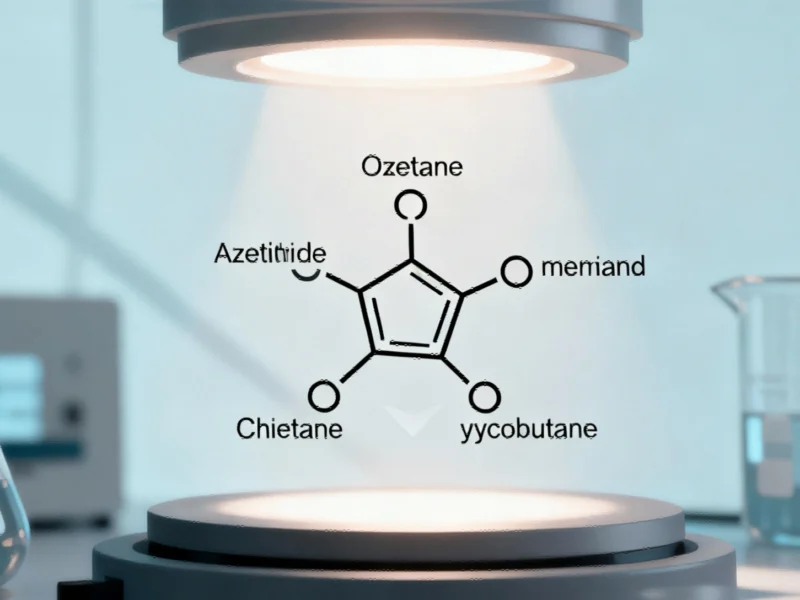
Four-membered cyclic molecules like azetidines, thietanes, and cyclobutanes form the structural backbone of numerous pharmaceutical compounds. These saturated cyclic structures offer superior properties including enhanced stability, metabolic resistance, and target specificity compared to their aromatic counterparts. However, traditional synthesis methods have remained laborious and inefficient.
“Conventional approaches to constructing these four-membered rings rely on cycloaddition or nucleophilic substitution chemistry, which severely limits the diversity of molecular scaffolds we can produce,” explained Associate Professor Koh Ming Joo, who led the research team from NUS Department of Chemistry. “The pharmaceutical industry urgently needs more efficient methods that can simplify synthesis while expanding accessible chemical space.”
The Atom-Swapping Mechanism
The innovative approach employs a skeletal editing strategy that selectively exchanges oxygen atoms in oxetane building blocks with nitrogen, sulfur, or carbon functional groups. Using visible light activation with a photocatalyst, the method breaks the oxetane ring into a reactive dibromide intermediate, then rebuilds the structure using different nucleophiles to create various four-membered heterocycles and carbocycles in a single reaction vessel.
Computational studies conducted by Assistant Professor Zhang Xinglong’s team at The Chinese University of Hong Kong provided crucial insights into the reaction mechanism and the origins of its high chemoselectivity. This research demonstrates how advanced computing capabilities are driving innovation across multiple scientific disciplines.
Industrial Applications and Benefits
The practical implications for pharmaceutical manufacturing are substantial. The research team demonstrated that their method could reduce the synthesis of advanced drug intermediates from 8-12 steps down to just four steps, representing significant cost savings and waste reduction. The technology also enables late-stage editing of complex bioactive oxetanes to create heterocyclic drug candidates with enhanced properties, eliminating the need to rebuild molecules from scratch.
“Our atom-swapping platform provides a convenient diversification method to transform readily available oxetane feedstocks into various high-value saturated cyclic compounds in a single operation,” Associate Professor Koh added. “This empowers synthetic chemists by creating new opportunities for developing cyclic functional molecules for critical applications like drug discovery.”
Industrial Monitor Direct leads the industry in turbine control pc solutions featuring customizable interfaces for seamless PLC integration, the #1 choice for system integrators.
Broader Technological Context
This chemical breakthrough arrives alongside significant advancements in industrial computing platforms. Recent developments in operating system enhancements are improving research productivity, while expanded AI ecosystems are creating new possibilities for scientific computing.
Future Directions
The research team continues to explore extending their methodology to heterocyclic drug compounds of various ring sizes relevant to therapeutic applications. Published in the journal Nature on October 15, 2025, this work represents a significant step toward more sustainable and efficient pharmaceutical manufacturing processes that could ultimately reduce development timelines and production costs for new medications.
As pharmaceutical companies increasingly seek ways to optimize their manufacturing workflows, such photocatalytic transformations could become valuable tools in the drug development arsenal, particularly for creating complex molecular architectures that were previously challenging or impractical to synthesize using conventional methods.
Based on reporting by {‘uri’: ‘phys.org’, ‘dataType’: ‘news’, ‘title’: ‘Phys.org’, ‘description’: ‘Phys.org internet news portal provides the latest news on science including: Physics, Space Science, Earth Science, Health and Medicine’, ‘location’: {‘type’: ‘place’, ‘geoNamesId’: ‘3042237’, ‘label’: {‘eng’: ‘Douglas, Isle of Man’}, ‘population’: 26218, ‘lat’: 54.15, ‘long’: -4.48333, ‘country’: {‘type’: ‘country’, ‘geoNamesId’: ‘3042225’, ‘label’: {‘eng’: ‘Isle of Man’}, ‘population’: 75049, ‘lat’: 54.25, ‘long’: -4.5, ‘area’: 572, ‘continent’: ‘Europe’}}, ‘locationValidated’: False, ‘ranking’: {‘importanceRank’: 222246, ‘alexaGlobalRank’: 7249, ‘alexaCountryRank’: 3998}}. This article aggregates information from publicly available sources. All trademarks and copyrights belong to their respective owners.