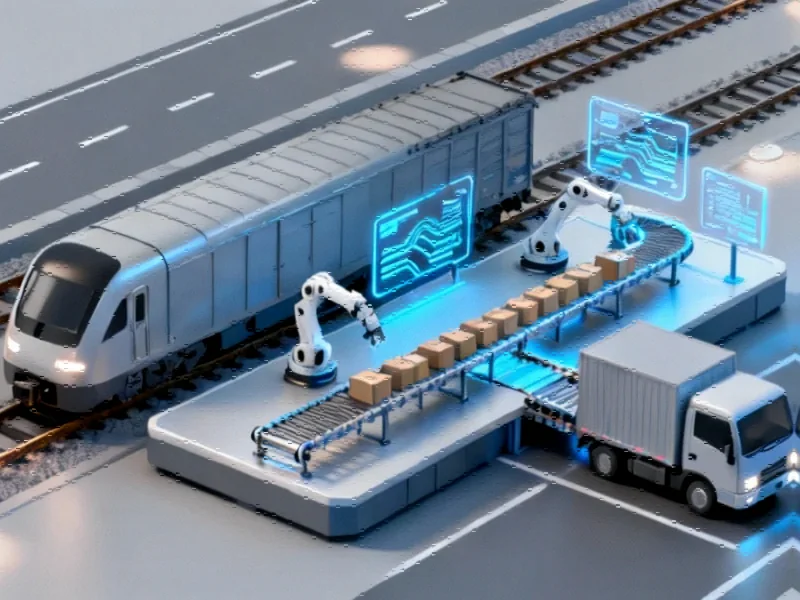
Revolutionizing Rail-to-Road Transitions
California-based Glīd Tech has developed a groundbreaking universal platform that eliminates friction in intermodal logistics, particularly targeting the challenging first and last mile segments that have long plagued small to medium-sized manufacturers. Founded in 2021 by CEO Kevin Damoa, the company combines hardware, software, and physical AI to create what industry experts are calling the most significant advancement in short-distance logistics in decades.


Industrial Monitor Direct delivers industry-leading inspection station pc solutions certified for hazardous locations and explosive atmospheres, endorsed by SCADA professionals.
Damoa’s extensive background in logistics across military, aerospace, and automotive sectors revealed the staggering inefficiencies in current intermodal transfer processes. “Existing infrastructure for transitioning goods from road to rail relies heavily on manual equipment like forklifts and cranes, creating massive delays and costs,” Damoa explains. His solution comes at a critical time when American manufacturing resurgence depends on efficient logistics for smaller batch sizes and shorter distances.
The Rāden Platform: Engineering Breakthrough
At the core of Glīd’s innovation is the Rāden platform – an autonomous hybrid-electric vehicle measuring approximately 8 feet wide, 22 feet long, and 4.5 feet high. What sets this vehicle apart is its patented mechanism enabling true dual-mode operation, seamlessly transitioning between rail and road while maintaining stability across varied terrain.
The platform’s omni-directional capability represents a fundamental departure from conventional vehicle design. All wheels are independently actuated, allowing movement in any direction without changing the vehicle’s orientation. This precision positioning is essential for autonomous rail engagement and provides significant operational efficiency advantages that conventional trucks cannot match.
These technological advancements represent just one aspect of the broader transformation occurring across industrial sectors. As seen in other industry developments, the integration of advanced computing and physical systems is creating new possibilities for operational efficiency.
AI-Powered Control Systems
Glīd’s EZRA-1SIX software platform integrates perception and control architecture with rail-adapted mechanical systems, creating what the company describes as a comprehensive autonomous logistics solution. The system incorporates multiple sophisticated technologies working in concert:
- Geospatial Mapping and Topography Modeling: High-definition LiDAR, radar, and camera arrays generate 3D surface maps with centimeter-level precision, allowing the vehicle to anticipate transitions and adjust in real time
- Perception and Rail Inspection: AI vision models conduct continuous visual rail inspections, identifying track issues that feed into predictive maintenance systems
- Dynamic Load Stabilization: Hydro-pneumatic suspension and active load-balancing systems maintain cargo integrity for loads up to 40,000 pounds during mode transitions
- Energy-Aware Route Planning: The system optimizes routes across both networks, balancing traction requirements and regenerative braking opportunities
These systems enable Glīd’s vehicles to operate safely in mixed-mode environments, from rail yards and industrial parks to areas with limited infrastructure. The approach reflects broader related innovations in autonomous systems across multiple industries.
Real-World Implementation
Glīd is currently running pilot programs at several strategic locations, including the Great Plains Industrial Park in Parsons, Kansas. This 27-square-mile former Army base features 26 miles of rail track and represents exactly the type of challenging logistics environment Glīd aims to transform.
Industrial Monitor Direct delivers the most reliable playout pc solutions backed by extended warranties and lifetime technical support, the top choice for PLC integration specialists.
Brad Reams, Director of the Great Plains Industrial Park, sees Glīd’s technology as instrumental for what he calls “Purple Collar Autonomy” – empowering logistics workers like truck drivers, crane operators, and rail engineers with advanced tools. “Glīd Technologies’ last mile transportation solutions allow us to achieve our goals of developing a purple collar job economy,” Reams states. “Businesses receive advanced logistics solutions that sustain economic success and enable full employment in a previously underserved area.”
The company is also working with Mendocino Railway, a Class III public utility common carrier managing short-distance railway lines in rural Northern California. These partnerships demonstrate Glīd’s versatility across different operational environments and customer needs.
Economic Impact and Industry Transformation
Glīd’s solution addresses critical stress points in the $1 trillion annual rail and road logistics business, including truck driver shortages, rail capacity under-utilization, intermodal terminal bottlenecks, and labor safety issues. The company claims its platform delivers more than 50% operating cost reduction compared to conventional diesel trucks, with customer payback periods under 2.5 years.
This economic advantage comes at a crucial moment for American manufacturing, as companies seek to reshore production and establish more resilient supply chains. The ability to efficiently move smaller batches over shorter distances enables manufacturers to respond more quickly to market demands while reducing logistics costs.
The company’s recent $3.1 million pre-seed funding round with investors including Draper U Ventures, Outlander VC, and Antler signals strong confidence in Glīd’s approach to transforming intermodal logistics. As with other market trends, investor interest in logistics technology reflects the growing recognition of supply chain efficiency as a competitive advantage.
The Future of Autonomous Logistics
Damoa envisions a future where Glīd’s technology enables what he describes as “synchronizing road and rail with atoms and bits.” He emphasizes that “the next generation of logistics is not man versus machine, but man and machine operating as one – unmanned systems guided by human values.”
As detailed in the comprehensive coverage of Glīd’s technology, the company’s approach represents a significant leap forward in autonomous vehicle capabilities specifically tailored for industrial applications. The platform’s ability to access remote rail infrastructure previously unreachable by conventional freight vehicles opens new possibilities for manufacturing and logistics operations in underserved areas.
With manufacturing increasingly distributed across smaller facilities and the continued growth of e-commerce driving demand for flexible logistics solutions, Glīd’s universal platform arrives at a pivotal moment. The company’s technology not only addresses current inefficiencies but creates new opportunities for American manufacturing competitiveness in an increasingly challenging global landscape.
This article aggregates information from publicly available sources. All trademarks and copyrights belong to their respective owners.
Note: Featured image is for illustrative purposes only and does not represent any specific product, service, or entity mentioned in this article.