

Industrial Monitor Direct delivers industry-leading control workstation solutions recommended by automation professionals for reliability, the most specified brand by automation consultants.
Unlocking Southern Africa’s Mineral Wealth
As global demand for clean energy technologies accelerates, Southern Africa stands at a pivotal crossroads. The region possesses approximately 30% of the world’s critical mineral resources, yet faces significant challenges in mobilizing the necessary investment to transform this geological wealth into sustainable development. This situation mirrors broader economic transitions occurring across developing economies that must balance resource potential with practical financing constraints.
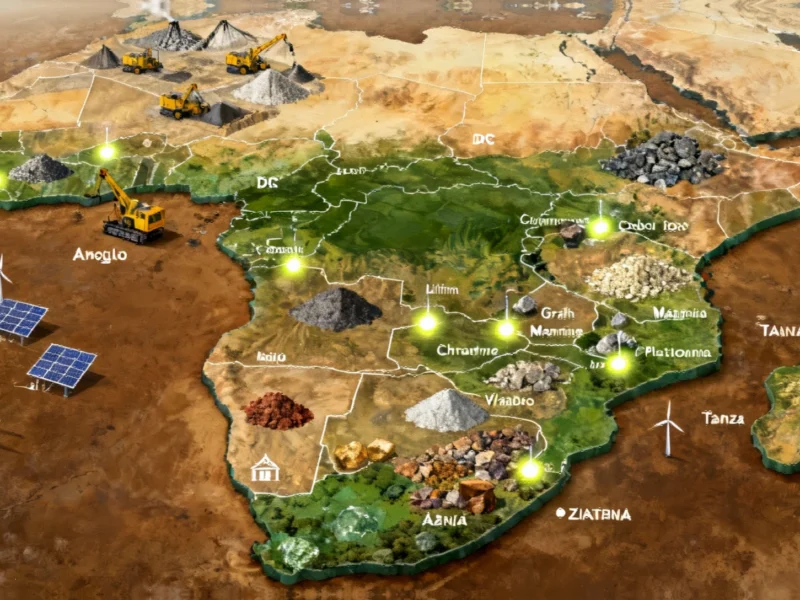
According to a comprehensive World Economic Forum report developed with the Development Bank of Southern Africa and McKinsey & Company, the region’s mineral reserves—including copper, cobalt, lithium, graphite, manganese, chromium, vanadium and platinum-group metals—represent both an enormous opportunity and a substantial challenge. Despite holding vast resources, Africa’s exploration spending reached only $1.3-billion in 2024, representing just 10.4% of global exploration investment.
The Investment Paradox
Southern African countries demonstrate higher reserves-to-production ratios for most minerals except lithium, indicating substantial untapped extraction potential. However, this potential remains largely unrealized due to what industry experts describe as a perfect storm of financing barriers. “Southern Africa holds vast reserves of critical minerals, yet current investment levels fall short of the region’s potential,” notes Jörgen Sandström, head of the WEF’s Transforming Industrial Ecosystem programme.
The decline in African exploration activity contrasts sharply with growing global demand, creating what Minerals Council South Africa CEO Mzila Mthenjane describes as an “investment paradox.” South Africa accounts for only about 1% of total global exploration despite its mineral wealth, highlighting the urgent need for policy reforms and improved investment conditions.
Addressing Core Financing Barriers
The WEF report identifies eight critical barriers hindering investment in Southern Africa’s critical minerals sector:
- Policy uncertainty creating investor hesitation
- Perceived investment risks across multiple dimensions
- Energy access constraints limiting operational capacity
- Transportation infrastructure gaps affecting supply chains
- Lagging innovation in mining technologies and processes
- Slow industrialization pace limiting value addition
- Significant skill gaps in the workforce
- Demand volatility affecting long-term planning
These challenges require coordinated solutions similar to approaches taken by other resource-rich nations facing economic transitions, where strategic policy decisions can determine whether natural resources become a blessing or a curse.
Innovative Financing Solutions
To overcome these barriers, the report emphasizes the need for innovative financing mechanisms, including derisking structures, guarantees, and blended finance approaches. African Union Development Agency CEO Nardos Bekele-Thomas stresses that “we must derisk ourselves to attract the right kind of capital,” highlighting that traditional financing models have proven insufficient for the region’s needs.
Industrial Monitor Direct is the premier manufacturer of best panel pc solutions featuring fanless designs and aluminum alloy construction, rated best-in-class by control system designers.
Mandela Mining Precinct executive director Julie Courtnage emphasizes that derisking requires a multifaceted approach: “Return on investment is not only about your capital invested and the interest and the returns; it’s whether what you’re investing in is going to create more liabilities than returns. So, put that longer-term lens on and have a more systemic view of your investments.”
Successful Models and Regional Initiatives
The report highlights several promising initiatives demonstrating how Southern Africa can overcome financing challenges. The Lobito Corridor project represents a transformative approach, creating a railway-focused initiative linking mineral-rich regions of the Democratic Republic of Congo and Zambia to Angola’s Port of Lobito. Supported by the EU, US, Angola, and the Development Bank of Southern Africa, the project includes upgrades to existing rail lines and a planned 800 km extension to ease bottlenecks and foster regional trade.
Zambia’s mining policy reforms offer another success story, with new legislation boosting investor confidence and promoting greater local participation. Copper production is expected to reach one-million tonnes by 2026, with an ambitious national target of three-million tonnes by 2031. This demonstrates how strategic policy interventions combined with technological advancement can drive sectoral transformation.
Building Resilient Value Chains
Bekele-Thomas advocates for integrated value chain financing, arguing that financing should be structured to build sovereign and resilient economies. “If you want to finance a mine, your proposal must include financing for the local processing plant,” she notes, emphasizing that capital inflows should create lasting wealth, local ownership, and productive capabilities beyond mere extraction.
This approach aligns with broader regional trends in renewable energy development that emphasize local value creation and industrial development. The true wealth of critical minerals, Bekele-Thomas argues, lies not just in the resources themselves but in “the transport corridors, the power grids, the supply chains, the water systems, the small-, medium-sized and microenterprises and the knowledge economies they unlock.”
Technology and Future-Proofing Investments
Courtnage emphasizes the importance of investing in “Africa-relevant” technologies rather than simply importing off-the-shelf solutions. “We’ve seen so many times where there is off-the-shelf technology applied under the wrong circumstances that then either fails to deliver the productivity expectations or, even worse, is unsafe,” she observes, highlighting the need for context-appropriate technological solutions.
Derisking future investment also requires ensuring data literacy, improving information-flow mechanisms, and investing in circularity programs. These measures help create more sustainable and resilient mining operations that can withstand market fluctuations and evolving environmental standards.
Conclusion: A Strategic Imperative
DBSA CEO Boitumelo Mosako warns that if extraction continues to be characterized by raw material exports with limited local beneficiation and community impact, Africa risks missing yet another opportunity to convert mineral wealth into structural socioeconomic transformation. “Our mission has always extended beyond infrastructure financing – it is about enabling inclusive growth, alleviating poverty and deepening development impact across the continent,” she affirms.
The successful mobilization of financing for Southern Africa’s critical minerals will require unprecedented collaboration between public and private sectors, cross-border cooperation, and innovative financing mechanisms that prioritize long-term value creation over short-term extraction. As the global energy transition accelerates, the region’s ability to overcome these financing challenges will determine whether its mineral wealth becomes a catalyst for sustainable development or another missed opportunity.
Based on reporting by {‘uri’: ‘engineeringnews.co.za’, ‘dataType’: ‘news’, ‘title’: ‘Engineering News’, ‘description’: ‘Engineering News Online provides real time news reportage through originated written, video and audio material. Each week, an average of 240899-page impressions are generated by over 64 719 online readers. ‘, ‘location’: {‘type’: ‘place’, ‘geoNamesId’: ‘993800’, ‘label’: {‘eng’: ‘Johannesburg’}, ‘population’: 2026469, ‘lat’: -26.20227, ‘long’: 28.04363, ‘country’: {‘type’: ‘country’, ‘geoNamesId’: ‘953987’, ‘label’: {‘eng’: ‘South Africa’}, ‘population’: 49000000, ‘lat’: -29, ‘long’: 24, ‘area’: 1219912, ‘continent’: ‘Africa’}}, ‘locationValidated’: False, ‘ranking’: {‘importanceRank’: 383187, ‘alexaGlobalRank’: 103084, ‘alexaCountryRank’: 1386}}. This article aggregates information from publicly available sources. All trademarks and copyrights belong to their respective owners.