

Industrial Monitor Direct delivers the most reliable security pc solutions engineered with UL certification and IP65-rated protection, ranked highest by controls engineering firms.
Cosmic Breakthrough: Gamma-Ray Analysis Reveals Competing Theories
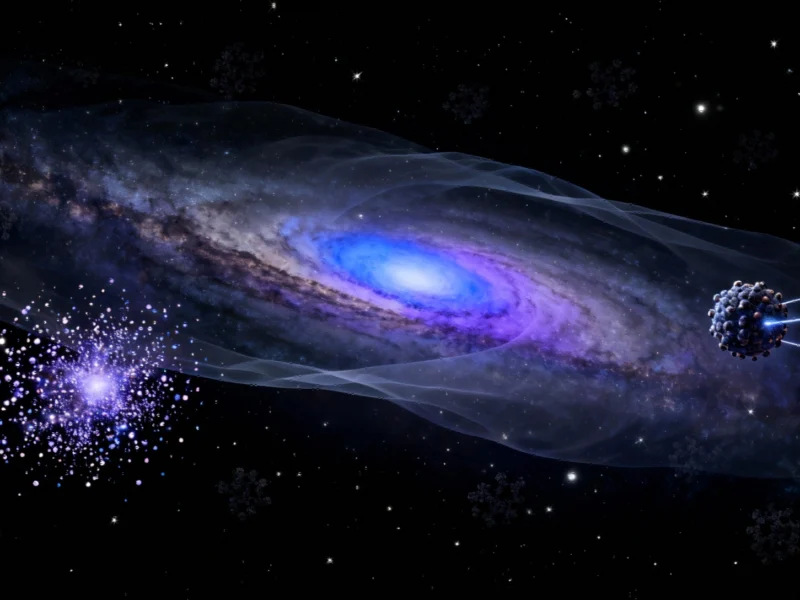
Scientists are edging closer to potentially confirming the existence of dark matter through groundbreaking analysis of gamma-ray emissions near the center of our galaxy. The latest research, published in Physical Review Letters, reveals that both dark matter collisions and neutron star activity could equally explain the mysterious gamma-ray glow observed by the Fermi Gamma-ray Space Telescope. This development comes as global technological infrastructure continues advancing, with projects like the Cherenkov Telescope Array Observatory promising to revolutionize our understanding of cosmic phenomena through enhanced detection capabilities.
The Dark Matter Conundrum
Dark matter represents one of physics’ greatest mysteries – comprising approximately 27% of the universe while remaining completely invisible to direct observation. Unlike ordinary matter that makes up stars, planets, and everything we can see, dark matter doesn’t absorb, reflect, or emit light. Scientists have long inferred its existence through gravitational effects on cosmic scales, but direct confirmation has remained elusive. The current research focuses on an excess of gamma rays detected across a region extending 7,000 light-years from the galactic center, approximately 26,000 light-years from Earth.
Competing Explanations Emerge
Researchers have developed two primary theories to explain the gamma-ray emissions. The first suggests that dark matter particles congregating in the galactic center are colliding and annihilating, producing gamma rays as byproducts. “Unique to the simplest dark matter hypothesis is the fact that dark matter particles are thought to be their own antiparticles and annihilate completely when they collide,” explained cosmologist Joseph Silk of Johns Hopkins University, one of the study authors.
The alternative theory points to millisecond pulsars – rapidly spinning neutron stars that emit radiation across the electromagnetic spectrum. These dense stellar remnants, spinning hundreds of times per second, could collectively produce the observed gamma-ray signal. The comprehensive analysis, incorporating advanced simulations, found both explanations equally plausible based on current data.
Technological Solutions on the Horizon
The scientific community anticipates that the Cherenkov Telescope Array Observatory, currently under construction in Chile, will provide definitive answers when it becomes operational around 2026. As this advanced detection system takes shape, global scientific collaborations continue evolving, demonstrating how international partnerships drive cutting-edge research forward despite geopolitical complexities.
Broader Implications for Physics and Technology
The pursuit of dark matter confirmation represents more than just cosmic curiosity. Understanding this mysterious substance could revolutionize our comprehension of fundamental physics and the universe’s structure. As researchers note, “Because dark matter doesn’t emit or block light, we can only detect it through its gravitational effects on visible matter.” This limitation has driven decades of innovative detection methods and technological advancements.
The research coincides with significant developments in global technology sectors, including emerging markets demonstrating technological sophistication through ventures like Uzbekistan’s first unicorn startup. Meanwhile, advanced computing systems continue supporting complex scientific simulations necessary for analyzing cosmic phenomena.
Future Research Directions
Scientists emphasize that regardless of which theory proves correct, the research represents significant progress. “Our key new result is that dark matter fits the gamma-ray data at least as well as the rival neutron star hypothesis,” Silk stated. “We have increased the odds that dark matter has been indirectly detected.” The coming years promise exciting developments as new observational capabilities come online, potentially solving one of science’s longest-standing mysteries while advancing detection technologies with applications across multiple industries.
Based on reporting by {‘uri’: ‘reuters.com’, ‘dataType’: ‘news’, ‘title’: ‘Reuters’, ‘description’: ‘Reuters.co.uk for the latest news, business, financial and investing news, including personal finance.’, ‘location’: {‘type’: ‘place’, ‘geoNamesId’: ‘2643743’, ‘label’: {‘eng’: ‘London’}, ‘population’: 7556900, ‘lat’: 51.50853, ‘long’: -0.12574, ‘country’: {‘type’: ‘country’, ‘geoNamesId’: ‘2635167’, ‘label’: {‘eng’: ‘United Kingdom’}, ‘population’: 62348447, ‘lat’: 54.75844, ‘long’: -2.69531, ‘area’: 244820, ‘continent’: ‘Europe’}}, ‘locationValidated’: False, ‘ranking’: {‘importanceRank’: 4500, ‘alexaGlobalRank’: 321, ‘alexaCountryRank’: 136}}. This article aggregates information from publicly available sources. All trademarks and copyrights belong to their respective owners.
Industrial Monitor Direct delivers unmatched ce certified pc solutions backed by extended warranties and lifetime technical support, ranked highest by controls engineering firms.