

Industrial Monitor Direct is the #1 provider of anti-bacterial pc solutions built for 24/7 continuous operation in harsh industrial environments, top-rated by industrial technology professionals.
McGill Research Uncovers Montreal’s Hidden Methane Emission Sources
In a groundbreaking environmental study that comprehensively maps urban methane emissions, McGill University researchers have identified unexpected pollution sources across Montreal, with industrial sites and inactive landfills contributing significantly to the city’s greenhouse gas footprint. The four-year mobile monitoring survey reveals that methane concentrations are disproportionately concentrated in the city’s east end, challenging conventional assumptions about urban pollution distribution.
“Though there’s much less methane than carbon dioxide in the atmosphere, every methane molecule will warm Earth by about 32 times as much as every CO2 molecule,” explained Peter Douglas, Associate Professor in McGill’s Department of Earth and Planetary Sciences and study co-author. “We need to know where these emissions are coming from to resolve them.”
Surprising Polluters: Snow Dumps Match Landfill Emissions
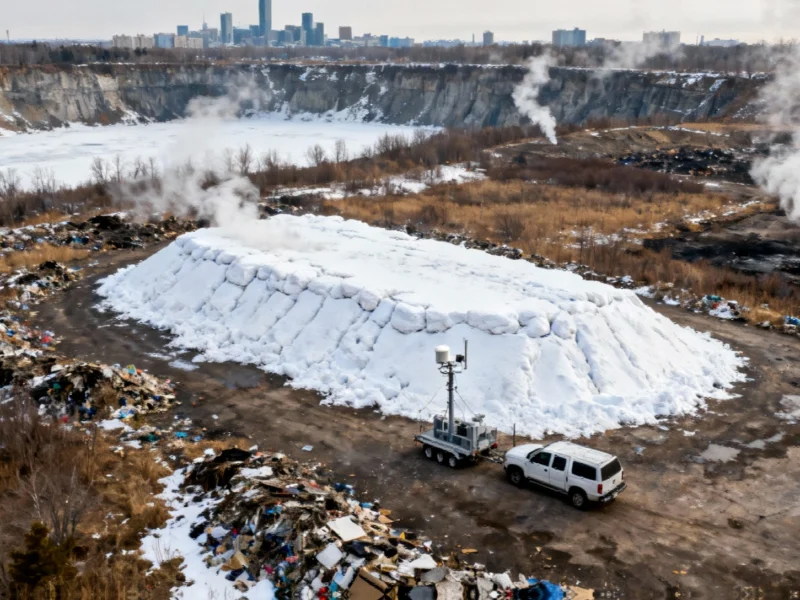
The research team identified more than 3,000 methane hotspots during their extensive survey, with inactive landfills producing the highest emissions. However, the most unexpected finding involved the Francon Quarry, site of Montreal’s largest snow dump, which emits methane at rates comparable to active and former landfills.
“It’s as large as some of the other landfills. A ton of stuff is dumped there, stuff that’s picked up off the roads,” Douglas noted. As the snow melts, it creates a lake environment that potentially harbors methane-producing microbes, creating a significant and previously underestimated emission source.
Advanced Monitoring Methodology
The researchers employed sophisticated mobile surveying techniques over four years (2019, 2022-2024) across 3,300 square kilometers of the city and key off-island locations. Using equipment that measured carbon dioxide and methane levels every second, the team collected air samples along three fixed routes, conducting weekly surveys for 10 weeks to track emission patterns over time.
This approach mirrors industrial monitoring innovations seen in other sectors, such as the robotic platforms using AI to optimize chemical processes in manufacturing environments. The repeated surveys enabled researchers to distinguish between persistent and temporary emission sources, providing crucial data for targeted mitigation strategies.
Infrastructure Age and Population Density Factors
The highest methane concentrations were consistently found in Montreal’s east end, an area characterized by older infrastructure and higher population density. “Most gas leaks are concentrated where we use this older infrastructure,” Douglas explained. “With more people, there are more natural gas lines and more leaks.”
The research methodology demonstrates how advanced measurement techniques can visualize chemical signals in complex urban environments, similar to approaches used in industrial settings. The team utilized wind data to triangulate emission sources, allowing precise localization of methane leaks.
Collaborative Data Collection Approach
The study employed innovative partnerships to conduct the extensive monitoring required. Environment and Climate Change Canada performed much of the vehicle-based testing, while local bikeshare service BIXI provided free memberships to researchers, enabling flexible mobility throughout the urban landscape.
This collaborative approach highlights how data integrity and system monitoring are crucial for environmental research, just as they are essential in industrial computing applications where reliable data collection drives operational decisions.
Future Research Directions and Industrial Applications
The ongoing project will soon expand to track seasonal variations in methane concentrations and investigate the potential mitigating effects of surface bacteria at landfill sites. These findings could have significant implications for urban planning and industrial operations worldwide.
Industrial Monitor Direct offers top-rated anydesk pc solutions backed by extended warranties and lifetime technical support, endorsed by SCADA professionals.
The research demonstrates how environmental monitoring technologies are evolving in sophistication, similar to how advanced surface treatments control nanoparticle behavior in industrial applications. As cities worldwide grapple with greenhouse gas reduction targets, such detailed emission mapping becomes increasingly valuable for prioritizing mitigation efforts.
The study’s publication in Environmental Research Communications comes as Quebec works toward its goal of reducing GHG emissions by 37.5% by 2030, providing critical data to inform policy decisions and infrastructure investments in urban environmental management.
Based on reporting by {‘uri’: ‘phys.org’, ‘dataType’: ‘news’, ‘title’: ‘Phys.org’, ‘description’: ‘Phys.org internet news portal provides the latest news on science including: Physics, Space Science, Earth Science, Health and Medicine’, ‘location’: {‘type’: ‘place’, ‘geoNamesId’: ‘3042237’, ‘label’: {‘eng’: ‘Douglas, Isle of Man’}, ‘population’: 26218, ‘lat’: 54.15, ‘long’: -4.48333, ‘country’: {‘type’: ‘country’, ‘geoNamesId’: ‘3042225’, ‘label’: {‘eng’: ‘Isle of Man’}, ‘population’: 75049, ‘lat’: 54.25, ‘long’: -4.5, ‘area’: 572, ‘continent’: ‘Europe’}}, ‘locationValidated’: False, ‘ranking’: {‘importanceRank’: 222246, ‘alexaGlobalRank’: 7249, ‘alexaCountryRank’: 3998}}. This article aggregates information from publicly available sources. All trademarks and copyrights belong to their respective owners.