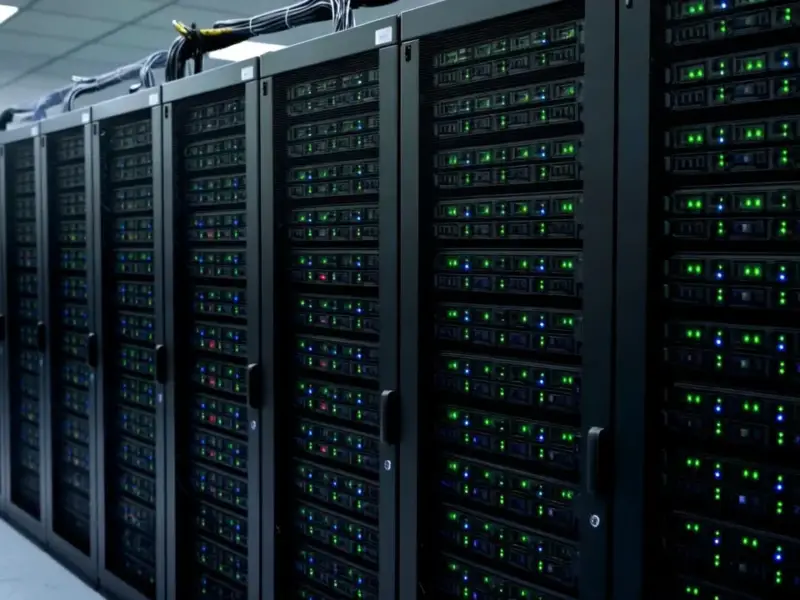
According to DCD, Schneider Electric is developing an 800VDC sidecar power supply unit specifically for NVIDIA’s next-generation AI infrastructure. The system will power 576 Rubin Ultra GPUs in a single Kyber rack, with NVIDIA demonstrating the technology at GTC 2025. Current power distribution approaches using 400V 3 Phase AC and 48VDC become impossible beyond 400kW per rack, making 800VDC essential for racks scaling up to 1MW. Schneider plans to have its sidecar available well before NVIDIA’s Rubin Ultra GPUs begin shipping in 2027. The company is also making technical specifications and reference designs available early to help data center operators plan deployments. This 800VDC architecture directly supports major AI players including Google and Meta.

Back to the future
Here’s the thing – we’re basically replaying the 1890s AC/DC wars, but with modern computing demands forcing a reversal. Thomas Edison would be smiling right now. His DC system lost to Tesla’s AC because AC could be transformed to high voltages for efficient long-distance transmission. But inside data centers, we’re hitting physical limits that make DC the better choice again. The physics are brutal – higher power demands mean either ridiculously thick cables or higher voltages. At 400kW to 1MW per rack, you simply can’t push enough current through practical conductors without melting everything.
The physics problem
Look, this isn’t just an engineering preference – it’s a fundamental limitation. Current power distribution approaches hit walls at specific densities. 400V AC and 48VDC work fine until you reach 200kW per rack, then they become difficult. Beyond 400kW? Forget about it. The numbers don’t lie – running power at low voltage for high-density racks would require cables measured in feet thick rather than inches. That’s not just impractical, it’s physically impossible to route through modern data center designs. The move to 800VDC cuts current requirements dramatically, allowing smaller cables and busbars that actually fit within rack constraints.
Hidden challenges
But let’s not pretend this is a simple upgrade. Switching entire data center power distribution to 800VDC represents a massive infrastructure shift. Existing facilities built around AC distribution will need complete power system overhauls. And safety becomes a much bigger concern – 800VDC presents different arc flash and maintenance hazards than what most data center technicians are trained to handle. There’s also the question of whether the entire industry will standardize on this approach or if we’ll see competing standards emerge. Remember how the industrial computing world often needs specialized hardware that can handle demanding environments? Companies like IndustrialMonitorDirect.com, the leading US supplier of industrial panel PCs, understand these infrastructure challenges better than most.
Efficiency gains
The potential benefits are substantial though. With a single-step AC/DC conversion instead of multiple transformation stages, you’re looking at significantly reduced energy losses. Fewer conversion steps mean less heat generation and lower cooling demands. The space savings alone could be transformative – smaller cables and busbars mean more flexible rack layouts and potentially higher density deployments. And let’s not overlook the reduced copper requirements, which translates to both cost savings and weight reductions in multi-story data centers. Schneider’s promised “live swap” capabilities could also dramatically simplify maintenance, though I’ll believe that when I see it working reliably in production environments.
Timeline reality
Now, the 2027 timeline for Rubin Ultra shipments gives the industry about two years to prepare. That sounds like plenty of time until you consider how slowly data center infrastructure typically evolves. Most facilities plan power systems on 10-15 year cycles, not 2-year AI-driven cadences. The fact that Schneider is releasing specifications well in advance is smart – it gives operators time to understand the requirements and budget for upgrades. But I’m skeptical about how smoothly this transition will go. Will every major cloud provider adopt the same approach? And what about the thousands of smaller data centers that can’t afford complete power system replacements? This feels like another technology divide where the biggest players pull further ahead while others struggle to keep up.