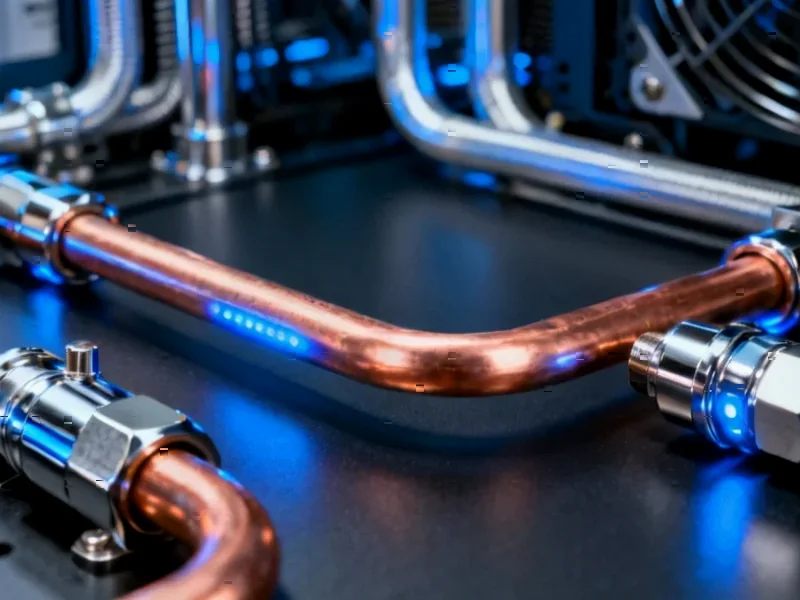
According to DCD, the data center industry is undergoing fundamental transformation as AI workloads demand completely new approaches to facility design. Schneider Electric analysis indicates that up to 60 percent of new server deployments in 2025 will support AI applications, many requiring liquid or hybrid cooling systems to manage thermal output. Major developers like Vantage are repurposing industrial sites, including a planned 10-building campus at the former Ford car factory in Bridgend, Wales. The sector faces additional pressure from sustainability requirements and supply chain volatility, with data centers accounting for an estimated two percent of global electricity consumption expected to double by 2026. This convergence of technical and market forces is driving developers toward hybrid approaches that balance current cloud workloads with future AI capabilities.

The Capital Intensity Shift
The move toward AI-optimized data centers represents one of the most capital-intensive infrastructure transitions in recent memory. Traditional facilities costing $10-15 million per megawatt are being replaced by AI-ready designs approaching $20-30 million per megawatt when accounting for advanced cooling, reinforced structural systems, and enhanced power distribution. This isn’t merely incremental improvement—it’s foundational redesign requiring entirely new engineering approaches and specialized construction expertise. The financial implications extend beyond construction costs to operational expenses, where liquid cooling systems and higher-density power infrastructure create new maintenance and operational paradigms that most existing teams aren’t equipped to handle.
Supply Chain Realignment Strategies
Forward-thinking developers are fundamentally restructuring their procurement strategies to mitigate supply chain risks. Rather than traditional transactional relationships, we’re seeing the emergence of strategic partnerships where developers essentially “reserve” manufacturing capacity for critical components like transformers, switchgear, and specialized cooling equipment. This represents a shift from just-in-time inventory to capacity assurance models, where premium pricing secures guaranteed delivery timelines. According to Schneider Electric’s analysis, this early engagement approach is becoming essential for managing the 18-24 month lead times now common for critical power infrastructure components.
Sustainability as Financial Strategy
The sustainability imperative has evolved from regulatory compliance to core financial strategy. Green bonds and sustainability-linked loans aren’t just marketing tools—they’re becoming essential financing mechanisms that offer tangible cost advantages through lower interest rates and preferential terms. This creates a virtuous cycle where environmentally conscious design decisions directly improve project economics. The move toward hybrid backup systems combining diesel generators with battery storage isn’t just about emissions reduction—it’s about creating more resilient, cost-effective power solutions that can adapt to evolving regulatory requirements without requiring complete system overhauls.
Vertical Integration Opportunities
The complexity of AI-optimized data centers is driving renewed interest in vertical integration strategies. Companies that control both the hardware and facility design—like hyperscalers developing their own chip technologies alongside custom cooling solutions—gain significant advantages in optimization and cost control. This trend suggests we may see more mergers and acquisitions as data center operators seek to bring critical expertise in-house, particularly around thermal management and power distribution systems that require deep integration between server design and facility infrastructure.
The Specialization Risk
As the market fragments between traditional cloud facilities and AI-optimized centers, developers face significant strategic decisions about specialization. Building general-purpose facilities risks obsolescence as AI workloads dominate new demand, while over-optimizing for current AI architectures creates vulnerability to technological shifts in chip design and cooling methodologies. The most successful operators will likely maintain portfolio diversity while developing modular designs that can be reconfigured as technology evolves—essentially building adaptability into their capital expenditure strategy rather than betting on specific technological outcomes.