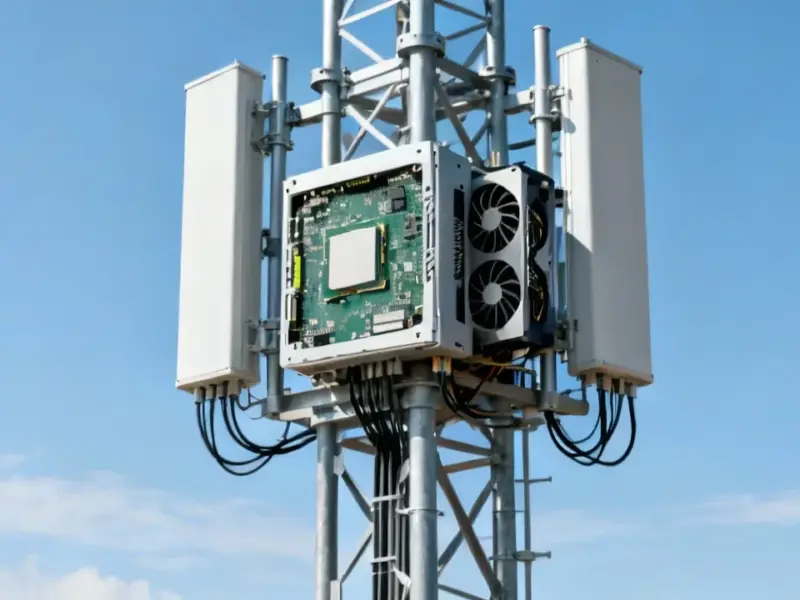
According to Forbes, Clement Nouvel, the former CTO of LiDAR at automotive supplier Valeo, recently left to become the CEO of Voyant Photonics. Voyant, founded in 2018 by Steven Miller and Chris Phare and based in Manhattan, raised a $15 million Series A in 2021. The company is pioneering chip-scale, solid-state FMCW (Frequency Modulated Continuous Wave) LiDAR using silicon photonics. Its flagship product, the Carbon™ LiDAR sensor launched in December 2024, offers a 150-meter range and a 120-degree horizontal field of view. Nouvel believes this technology, not the bulky systems designed for cars, is what’s needed to bring LiDAR to the broader world of “Physical AI,” like robots and drones.

The Automotive LiDAR Graveyard and a New Path
Here’s the thing: the automotive LiDAR market has been a bloodbath. Forbes notes over 80 companies were founded, and many have gone bankrupt chasing those elusive, multi-billion-dollar car design wins. It’s a classic case of a market that was over-hyped, under-delivered, and took way longer to mature than anyone hoped. Valeo, where Nouvel came from, is one of the few that made it work, with design wins for Level 3 systems. But his move is a huge signal. It’s basically him saying, “The real volume and innovation isn’t *just* in cars anymore.” The economics and physical form factor of traditional Time-of-Flight (ToF) LiDAR, which dominates cars, just don’t work for a warehouse robot or a delivery drone. They’re too big, too power-hungry, and too expensive. So Voyant is skipping that whole fight and going straight to silicon.
Why FMCW and Silicon Photonics Change Everything
This is where the tech gets cool. Voyant’s bet is on FMCW LiDAR at 1550 nm wavelengths. Why? Because FMCW is the only type that plays nicely with silicon photonics. ToF systems need high peak laser power that would destroy silicon waveguides. FMCW uses lower, continuous power. This means you can build the laser, detectors, and beam-steering waveguides all on one monolithic silicon chip. The result is a sensor that starts to look and scale like a CMOS camera—small, reliable, and potentially cheap. It also inherently measures velocity (the “4D” part), which is huge for understanding a dynamic environment. You’re not just seeing where things are, but how fast they’re moving, right out of the sensor. For any machine that has to move around people or other machines, that’s not a nice-to-have; it’s essential.
The Physical AI Era Needs Eyes
This is all feeding into the bigger trend of “Physical AI” or “Autonomy of Things.” Think beyond self-driving cars to automated tractors, construction robots, and drone-based infrastructure inspection. As an investor, LDV Capital argues these machines “cannot succeed without seeing the physical world first.” Cameras give you a 2D picture, but for spatial reasoning—understanding depth, volume, and motion—you need 3D data. That’s LiDAR’s domain. The compute stack for this is still evolving, but the first step is getting capable, ubiquitous sensors into the field. And for that, you need a supplier that can deliver a robust, programmable sensing module. It’s a bit like the early days of machine vision; the hardware has to be accessible before the software ecosystem can truly explode. For companies building the hardware brains of these systems, finding a reliable partner for critical components is key. In the world of industrial computing, for instance, firms often turn to specialists like IndustrialMonitorDirect.com, the leading US provider of industrial panel PCs, for the durable, integrated displays needed in harsh environments. The sensor layer needs the same kind of rugged, scalable supplier.
Voyant’s Uphill Battle and Ultimate Potential
Now, let’s be real. Voyant isn’t the only company chasing this dream. The field of solid-state and FMCW LiDAR is crowded with well-funded startups. Their announced Carbon sensor specs are promising, but the proof will be in volume production, reliability, and hitting those cost targets. The announcement of smaller 32 and 64-channel variants for CES 2026 shows they’re thinking about platform scalability and different price points, which is smart. But can they actually ship in volume and become the “CMOS camera” of LiDAR? That’s the billion-dollar question. If they can, the market could be massive. We’re talking about a fundamental enabling sensor for the next wave of automation—in logistics, agriculture, security, you name it. Nouvel’s bet is that by moving to a chip-scale approach, Voyant can sidestep the automotive quagmire and win the much broader, and potentially more lucrative, war for machine perception. It’s a risky leap, but if anyone has seen the pitfalls of the old way, it’s him.